Objective
Determine whether a simple browser extension can make reading the morning news slightly less exhausting by temporarily removing Donald Trump-centric stories from major news sites.
The requirement was straightforward: I still want access to the news. I just don’t necessarily want Donny commanding my attention before I’ve finished my coffee.
Materials and Methods
The experiment began with The New York Times and a small piece of JavaScript.
The first version searched headlines for references to Donald Trump, identified the surrounding story, and hid it when I clicked a button in the upper-right corner:
Bye, Donny! 👋
Clicking the button again restored everything.
That worked surprisingly well.
So naturally, scope creep began immediately.
The script became a Chrome extension, gained persistent settings, and expanded beyond the Times to Reuters, The Philadelphia Inquirer, The Wall Street Journal, The Washington Post, AP, CNN, NBC, CBS, ABC, NPR, USA Today, and Fox News.

Experimental Procedure
The basic algorithm is intentionally unsophisticated:
- Find headlines referring to Trump.
- Determine which chunk of the webpage represents that story.
- Hide that chunk.
- Leave everything else alone.
- Restore it when requested.
Step 2 turned out to be approximately 90% of the experiment.
News websites apparently agree on remarkably little about how a news story should be represented in HTML.
Reuters provided the first useful failure. The software successfully removed a Trump headline while helpfully leaving behind the photograph and summary belonging to the now-invisible story.
That wasn’t exactly the desired result.
The filter was modified to identify the complete story card rather than simply hiding the nearest convenient HTML container.
Reuters then behaved.
CBS behaved surprisingly well.
CNN required additional persuasion.
Results
The current beta works across 13 major news outlets.
Before filtering:
Bye, Donny! 👋

After filtering:
Donny’s Gone… · 51 hidden
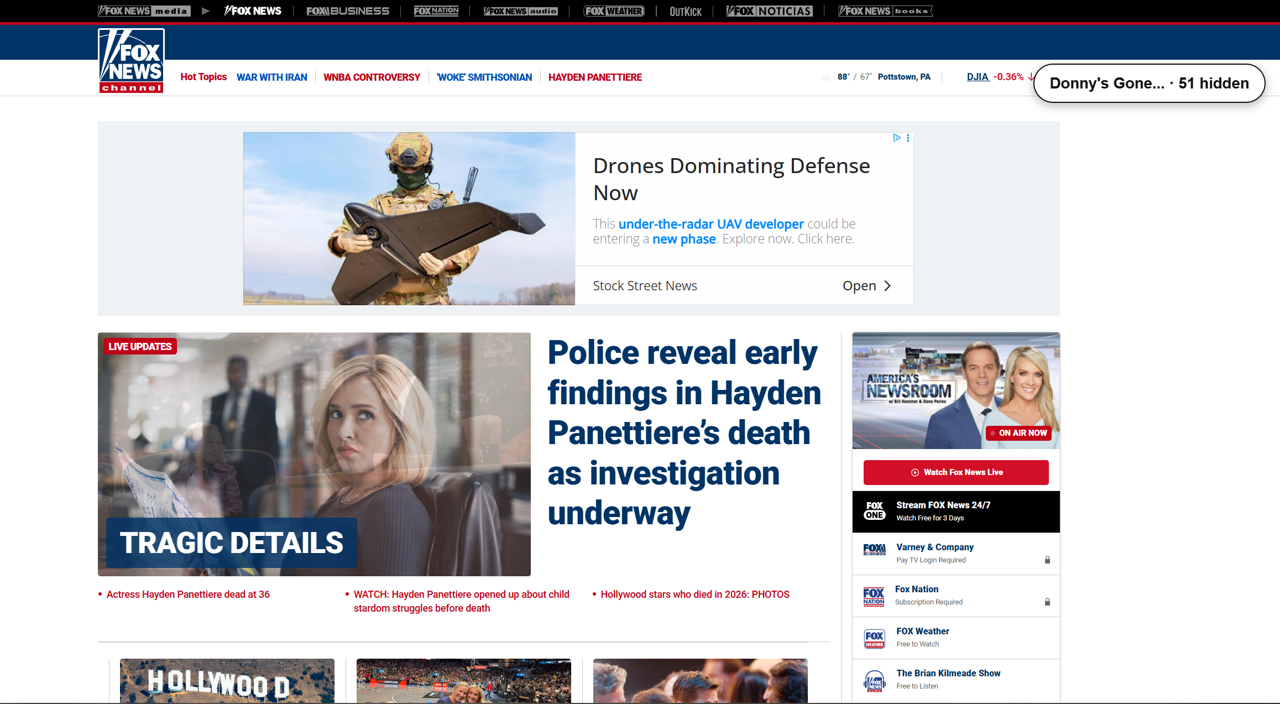
That last number appeared during testing on Fox News, which may itself constitute an experimental result.
The extension doesn’t permanently block anything. One click restores the stories. It also doesn’t send browsing information anywhere: the filtering happens locally in the browser.
The objective isn’t censorship. It’s attention management.
I can read those stories whenever I decide they’re worth reading. They just don’t get to make that decision for me.
Discussion
There is an obvious cultural ancestor to the name.
If you’re of a certain age, you understand “Bye, Felicia.”
If current events are bringing you down every morning, we’d like you to try:
Bye, Donny! 👋
The interesting part of the experiment wasn’t getting JavaScript to make a headline disappear. That took very little time.
Getting it to reliably understand what constitutes a story across thirteen independently designed news sites was the actual engineering problem.
It also produced a useful reminder about software projects: a prototype that works perfectly on one system demonstrates that it works perfectly on one system.
Reuters, CNN and CBS took care of demonstrating the rest.
Current Status
Experiment successful enough to release into the wild.
Bye, Donny! 1.2 Beta has been packaged as a Chrome extension and submitted for distribution through the Chrome Web Store. The source is also maintained on GitHub.
The next phase is less about adding features and more about seeing what happens when people other than me use it—with different subscriptions, screen sizes, advertisements, login states, and news-reading habits.
That should provide plenty of opportunities for additional failure.
Which, after all, is why this is an experiment.
Built by PropellorHat Development and CockatooStew LLC.
Next Experiment: Put it in front of actual humans.